The Multiple Isn’t The Value.
What actually determines what buyers are willing to pay?
Business owners ask us a version of the same question all the time: What is my business worth? It’s an understandable question. For many owners, the business represents years – or decades of work, risk, relationships and accumulated value. Naturally, they want to put a number on it. And often, that conversation begins with a multiple.
THE BENCHMARK
In Q2 2026, GF Data reported an average purchase-price multiple of 7.0x trailing twelve-month adjusted EBITDA across its reported transactions. That number is useful. But there is an important distinction every business owner should understand
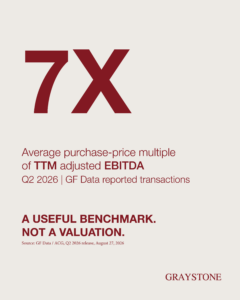
A multiple is a benchmark. It is not a valuation. Source: GF Data / ACG, Q2 2026 release, August 27, 2026. WHAT BUYERS ACTUALLY UNDERWRITE Buyers don’t buy EBITDA alone. They buy the business behind it. Two companies can produce the same EBITDA and represent very different opportunities to a buyer. Sophisticated buyers look beyond the headline financials to evaluate the quality, durability and risk behind those earnings.
WHAT BUYERS ACTUALLY UNDERWRITE
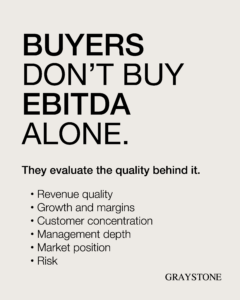
Buyers don’t buy EBITDA alone. They buy the business behind it.
Two companies can produce the same EBITDA and represent very different opportunities to a buyer. Sophisticated buyers look beyond the headline financials to evaluate the quality, durability and risk behind those earnings. Revenue quality. How predictable and recurring is the revenue? Growth and margins. Is performance sustainable, improving or beginning to slow? Customer concentration. How dependent is the company on a small number of relationships? Management depth. Can the business operate successfully without the owner? Market position. What makes the company difficult to replicate or replace? Risk. What could materially change future performance?
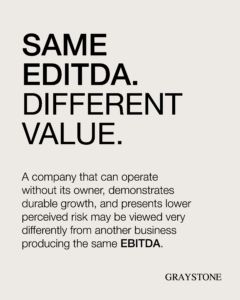
SAME EBITDA. DIFFERENT VALUE.
Imagine two businesses generating the same adjusted EBITDA. One has recurring revenue, diversified customers, consistent margins, an experienced management team and a clear path for continued growth. The other relies heavily on its owner, generates a meaningful percentage of revenue from a handful of customers and has less visibility into what growth looks like over the next several years.
THE BETTER QUESTION
For an owner, the more useful question may not be “What’s my multiple?” It may be: “What would make my business more valuable to a buyer?” That question changes the conversation because many of the characteristics that can influence value aren’t created when you decide to sell. Management depth, customer diversification, recurring revenue, consistent financial reporting, margin improvement and owner independence all take time to build. Understanding how a buyer may view your business can therefore matter years before a transaction ever takes place.
PREPARATION CREATES OPTIONS
You may ultimately decide to sell. You may bring in a partner. You may make an acquisition. You may continue growing independently. Or you may simply want to understand the value you’ve created. The objective isn’t to force a transaction. It’s to understand your position well enough to make the right decision when the opportunity comes. At Graystone, we work with Lower Middle Market business owners to understand the factors driving value, evaluate the buyer landscape and prepare for the decisions and transactions that shape what comes next.